Tuesday, September 24, 2019

The Two Faces of Travel, Part 3

You knew it was coming. My previous blog post (hazards, warnings, danger, risk) was just a prelude to the bigger story: what I endured during my recent month in Europe.
If you’ve been following Facebook (which is more up to date than this blog), you know that I had a nice yoga retreat in the Czech Republic, a nice visit to small towns in Istria and Italy, a nice visit with friends in the French Alps, and a nice canal boat cruise on the Canal de Garonne. I am smiling with memories.


But I learned as a journalist that news sells best if it is juicy, suspenseful, scary, exaggerated, or just plain lies. (As a fellow journalist says, “If it bleeds, it leads.”) If you want to know more about “nice” towns, see my photos on Facebook or consult TripAdvisor. As thinking machines, we revel in what happened to others, and rejoice that it didn’t happen to us.

So rejoice, readers. I’m happy to serve up some grip and grim.
For starters, a mosquito bit me the moment I stepped onto the tarmac at Copenhagen airport—the first since I left Washington, DC, in August. (The 24 other still-itchy bites on my arms and legs are from no-see-ums in southern France.)

Before that minor inconvenience, working backwards from this evening, here are the tales I have to tell:

1-I offer my rating of the low-budget European airline RyanAir: two stars below EasyJet. Paying extra for “priority” boarding was a waste of 70 euros. There was no announcement, no separate line, no pre-boarding, no special treatment of “priority” passengers like Pope and me from the hordes jamming the gate this afternoon.

I could have spent the extra money on a nicer hotel and my beloved French specialty, almond croissants.

2-Somewhere between boat and Bordeaux yesterday, my tablet computer disappeared. Lost or stolen at a French dock, train station or hotel.

3-For two days we’ve emailed a hotel booked on hotels.com about late check-in in Copenhagen tonight, and another booked on booking.com about ferries to their island tomorrow. No answer, no answer, no answer. Finally purchased international cellular time to call. Got late-check-in instructions. Got nothing but promises to find a ferry that is running tomorrow.

4-The ferry problem is due to Pope’s having booked a room on a remote island in the North Sea, in the off-season, prepaid and non-refundable. Heavy rain and wind predicted. See former blog post: danger and risk follow me around.

Mostly, Pope has been a fine traveling companion for the second half of my trip; tonight, however, I am eying his portion of the travel arrangements with skepticism. 

5-After two days, my skull stopped bleeding where I hit it on a low ceiling. It’s still sore.

6-In Europe, elevators and escalators are scarce at train stations, bus stations, airports, hotels. Lots of concrete stairs to carry luggage up and down. 


My carry-on is 25 pounds; by Week 2, a wheel got bent on ancient cobblestones. My day pack is pushing 10 or 12 pounds. By Week 3, I had accumulated enough purchases to add an 8-pound tote bag. Can you feel the weight on my shoulders?

Thank goodness for the twice-weekly “boot camp” classes at my local Sport & Health. Lots of weight-lifting helped me prepare for luggage duty.

7-Continuing to work backwards: by the time my friend and I decided to visit Verona or Vicenza, all reasonably priced hotel rooms were gone. We made do with a tiny, dingy room at Hotel Mignon in Padua. Padua is a dingy city compared with stately, elegant Vicenza. (We never got to Verona.) However, Padua served up many intriguing twists; see previous blog post.

8-I lost 200 euros on the streets of Vienna, from a buttoned pocket, after visiting an ATM.

9-I arrived during the European heat wave. You probably read about it in your Detroit Free Press or Washington Post. I have been washing sweaty clothes in the sink every night. The no-see-ums thrive. And bite.


Shall I go on, or are you bored? Unfortunately for attracting readers, none of these incidents constitute serious, life-threatening dilemmas. For someone who visits many nations with complicated logistics, languages, and security risks, these fall into the category of minor or, at worst, medium-level travel complaints.

I didn’t fall off the walls of a cliff-top fortress.


I didn’t get smashed by a truck or even a mini Renault while walking in narrow lanes.

No one fell off the canal boat or got mugged in a dark corner. 

Even better, no nights were spent sleeping on the floor of a train station. (And only one night on the floor in Dublin airport.)

No, nothing absolutely terrifying or even remotely dangerous has happened to me in Europe so far. Nonetheless, don’t you agree that even petty theft, slight concussion, and substandard airlines make a more enticing story than nice castles, nice paintings, and tasty mushroom tagliatelle?

Thursday, September 12, 2019

Lost in Translation...? (Or Lost in the Mountains?)

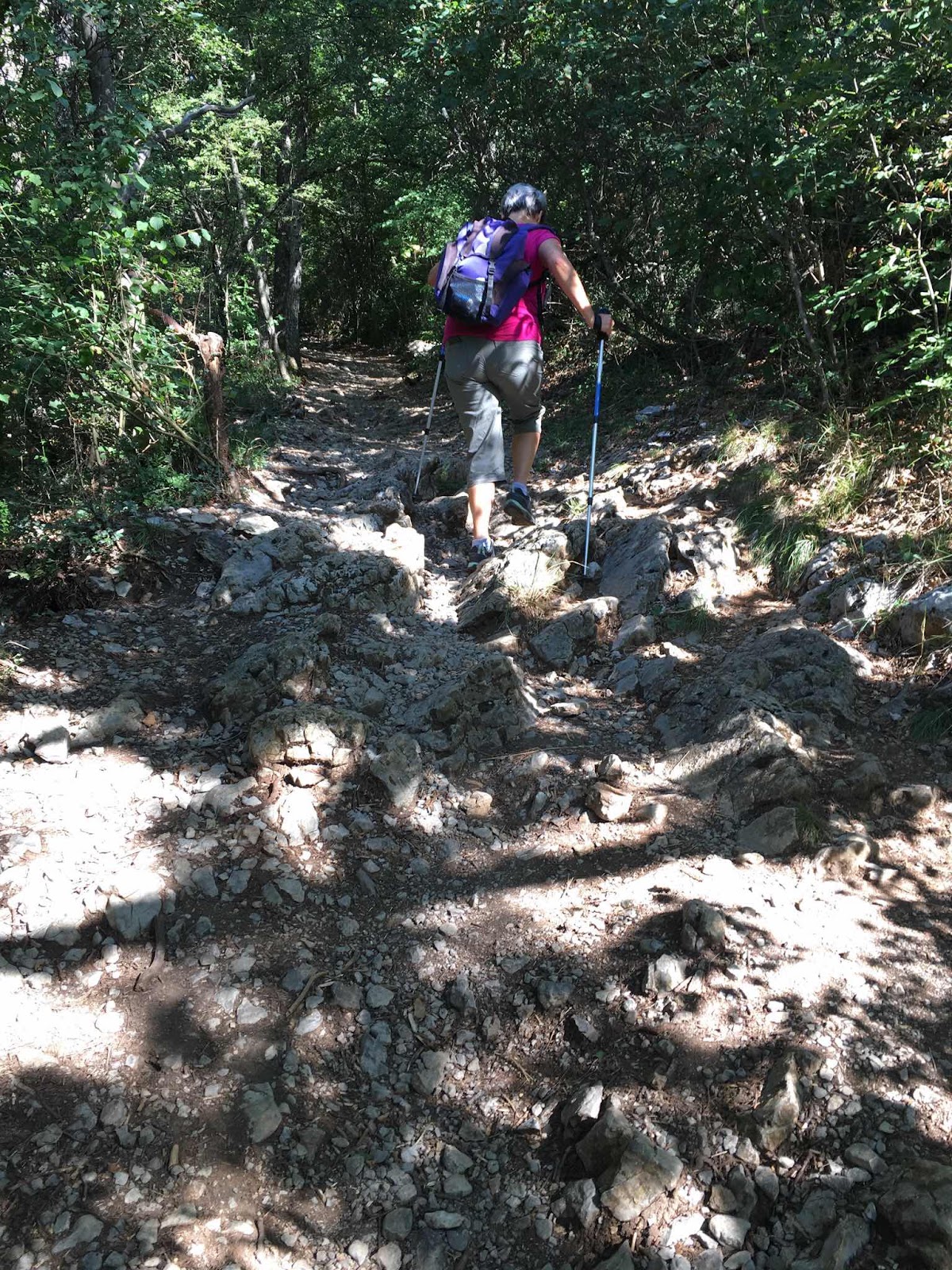
My communication in France is hit or miss. Sometimes I get it right, but more likely I’ll end up on the wrong train (not yet), get two apple tarts instead of one (yesterday), end up in the emergency room (in 2015), or get into unexpected situations. Wanting to cool down on a hot day by getting up into the mountains, I attempted the following conversation prior to starting up the trail to Mount Rachais, in the Chartreuse Mountains near Grenoble, France.

Me: “Will it be steep?”
“Non.”
Me: “But it looks like it goes straight up! No switchbacks!”


Me: “Will it be rocky?”
“Non.”


Me: “Will it be easy to find the way?”
“Mais oui (of course).”
Me: “But I don’t see Mont Rachais on these signs!”


Me: “Will it be a hot day?”
“Non.”
Me: (panting, sweating)


Me: “Will there be interesting scenery along the way?”
“Mais oui (of course).”
Me: “Um...”


Me: “Will there be a view at the top?”
“Non; seulement des arbres, malheureusement (only trees, unfortunately).”
Me: “Um...”


Me: “How will we get to the trailhead?”
“Les bulles.”
Me: “Bubbles...?????”


Me: “Can we take it slow and rest a lot?”
“Non. Vite! (We must hurry!)”
Me: “Ha ha, you didn’t mean that!”


Me: “How will we know when it’s time to turn around?”
“Ha ha. Silly woman, you have to get all the way to the top.”


Tuesday, September 10, 2019

Empires and Architecture: Revisiting History

Romeo, Romeo, where art thou?


Nobody knows for sure. There are castles in Montecchio Maggiore rumored to be “Romeo’s and Juliet’s.” But there is no hard evidence that the Montagues and Capulets existed, let alone lived in the area. Ditto for the fortress-like “Montague” villa and romance-tinged “Juliet’s” balcony in Verona, visited by millions. 


So my friend Deanne and I skipped that “fake news” scene and stuck with the facts. In Padua and Vincenza, the architecture and history are well documented. 


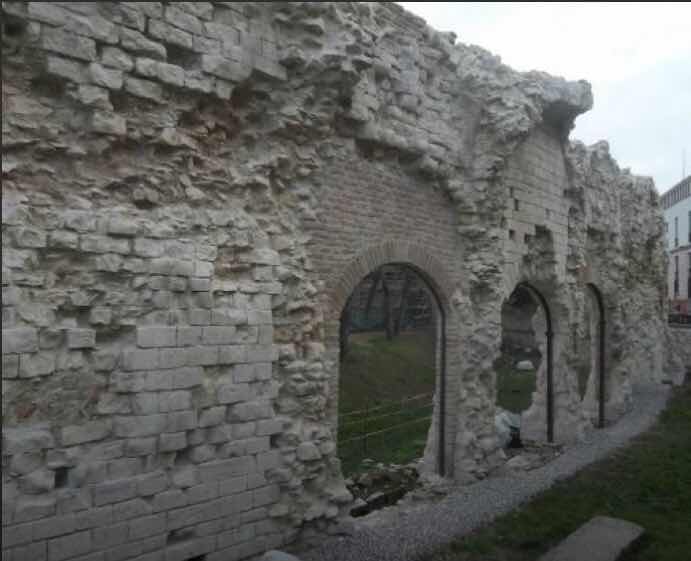
The first thing you see on entering Padua is the remains of a Roman amphitheater, begun around 30 B.C. 


Piazzas dei Signori and delle Erbe, next door to each other, feature an astrological clock with signs of the zodiac—Libra is missing—and the magnificent Palazzo della Ragione, built in the 1200s and used as a law court five centuries later.


In my opinion, the Basilica honoring St. Anthony of Padua tops most of the churches and cathedrals I’ve seen in Europe. The initial structure dates from the 1200s, with additions ranging from a Renaissance chapel of the 1500s to elaborate 1700s Baroque sculptures, designed to show off power and wealth. Some of it could be called gaudy. But I was impressed. 


A bonus in Padua was the city’s hidden gems. Rounding a corner to find marble columns, classical statues, or Venetian-style windows. Green parks. Street markets with racks and racks of cheap Italian-designed clothes.


Not to mention the lively street scenes during happy hour—which takes place outdoors, in all parts of the city, and lasts roughly from 2 pm to 8 pm, when restaurants finally get around to serving real food.


Down the road is another gem, relatively unknown or at least uncrowded by hordes of tourists. Vicenza is passed over by the thousands streaming into Verona to swoon under “Juliet’s” balcony. Yet the architect Palladio of Vicenza left an indelible mark on the world, not just on the 16th-century buildings in his home town, but influencing architecture as far and as late as Thomas Jefferson’s home at Monticello and the University of Virginia’s Rotunda.


Palladio’s Teatro Olimpico wowed audiences with the first-known scenery painted in perspective; i.e., the scenes appear to stretch to the far horizon. The first performance was “Oedipus.” The original sets are still used. 


Vicenza is another adventure in hidden gems—from porticos to parks to thick, hot sipping chocolate. (Think melted chocolate bar.)


We may have missed gazing on turrets possibly graced by a legendary Romeo. But we found architectural spectacles and evidence of real stories from the past.


Wednesday, September 4, 2019

Croatia to Italy...Somewhere, Sometime

Just to keep things interesting, Deanne and I boarded a ferry today, a nice change from long bus and car journeys. After three days in the touristy and meat-friendly Istrian coast of Croatia, we are heading for the land of pasta, tomato, and eggplant (Italy). And more tourists.

Waiting for the ferry in Rovinj; old town in background

To make things even more interesting, we neglected making hotel reservations and decided to just “show up” somewhere, sometime. This strategy worked in the days of Lonely Planet and tourist information counters. This time it is the result of profound indecision, and a shortage of rooms in a lovely traditional B&B with a garden, balcony, view, or at least a hearty breakfast, in the right place at the right time. At least according to Booking.com and Expedia.

The indecision was exacerbated by minor illness on my part—cold, sinus, and stomach upset. Too weak to swim, shop, or visit the historic churches in Rovinj, let alone research our next destination. Our room in an ancient building of stone walls and lintels in the heart of Old Town was a pleasant place to lie down and lent a touch of history to our stay.


Our room in ancient stone building, old town Rovinj

The Rovinj seafront is crowded with dozens—hundreds?—of outdoor restaurants and an equal number of shops. A tourist Mecca. 


Deanne swam off the rocks in the warm, clear Adriatic Sea—with the giant jellyfish—while I slept. 


Stairs down to the water; jellyfish are easy to spot

Together we searched markets and menus for fruit, salad, or a side dish of potatoes and greens. The local tomatoes are ripe and the ricotta is fresh and sublime.

Farmers market on Tuesdays

We boarded another bus briefly for a trip down the coast to the Roman amphitheater at Pula, near the bottom of the Istrian peninsula. Sixth largest in the world, now a concert venue.


Roman coliseum-turned-concert hall

Soon the ferry will dock at Trieste, a maritime port of the Romans, Hapsburgs, Italians. We will have lunch in the piazza then meander to the train station to contemplate our next move.