Windy Auckland is known as the "City os Sails." It is home to thousands of sailing vessels, and almost all America's Cup teams include one or more Kiwis. Unlike this reluctant sailor (me), ambitious sailors love the feel of their boat slicing through 20- to 30-knot winds, while leaning over the gunwale to balance the keel as she heels.
Auckland is also the jumping-off point for a dozen other adrenaline-pumping sports that attract hordes of youth from around the world: zip-lining, surfing, skiing, sky-diving, rafting, and, perhaps the most popular: bungee-jumping. It's in all the ads and is the talk of the hostels.
Being closer to a retirement home than a triathlon, Pope and I are inclined to engage in more sedentary sports: scenic bus rides, happy hour at the brewery, short walks in the hills. The peer pressure at the hostels in enormous, though. So today we headed out of Auckland to join the young'uns in more ambitious activity...and ended up settling for what is perhaps the ultimate sedentary sport: soaking in a hot tub.
Ah! But it was a natural hot tub! We bypassed the "swimming pools" fed by thermal springs--think children and chlorine--and headed straight for Hot Water Beach. Where hundreds of tourists in flip-flops congregate every day at low tide to rent shovels and dig their way down to hot magma. Or at least to the hot springs under the sand, the outlets of boiling magma deep inside the planet. The highest temperatures in the sand reach 145 degrees Fahrenheit or so.
Now, about those honeybees. I am mildly allergic to almost all insect poisons. Bee and wasp stings in Michigan, Virginia, or Colorado will swell to the size of a quarter and cause discomfort. I carry Benadryl everywhere, and an EpiPen, just in case. Never had a serious problem.
Today I felt the wrath of a New Zealand stinger. And it was a very serious problem. I was driving as we left the outdoor soaking chambers. A few miles down the road--YIKES!! I tried my best to keep the car on the narrow switchbacks while screaming bloody murder and swatting at my back, where something fuzzy was inserting hot knives in my back and twisting them, just for effect. Needless to say, I barely missed tumbling down the cliff in our right-hand-drive Nissan.
Was I really that much tastier than the locals? Was it a honeybee, wasp, or nefarious Kiwi plot to drive tourists away from the hot springs? The pain and numbness radiated down my arm and up my neck for the next eight hours, even after Benadyl.
Zip-lining? No way; it's in the forest with spiders and beetles. Bungee-jumping? No way. I'm way too chicken. Think I'll just retire to my favorite haven for sedentary seniors: my bunk. And nurse my aching back muscles while leaving the ambitious athletics to the 20-year-olds.
Tales of High Seas, Low Tides, and Escapades Ashore
Sunday, February 12, 2017
Tuesday, February 7, 2017
This is What Retirement Looks Like
"Tell me what democracy looks like!" "THIS is what democracy looks like!"
The chants were defeaning. The crowds stoked. And I was there. Circling the White House to defeat a pipeline. In the midst of a million stubborn women. And at the Supreme Court, helping Bernie and friends challenge the travel ban.


Yes, it's true. I was there, and I will go again. I have the will, the reasons, and--just as important--I have the time to act on issues I care about.
Do you want to know what retirement looks like? THIS is what retirement looks like.
My Facebook readers have gotten previews of my post-career shenanigans, from biking to the cherry blossoms on a weekday to serving as first mate on a boat to traveling three months in France.
Keep plugging away at those annual reports! Keep stowing away those paychecks! There IS reward in return for your daily investment in the world of toiling for others. If not always lots of money, at least lots of time.
I am on a plane to New Zealand. For a month. That might sound expensive, and yes, the airfare cost one-third of my pension this month. A rental car will use up another third. But this is why I scrimped and saved for 45 years.
To all of my colleagues who complained about The Daily Grind: I get it. I was in the Metro and the lunchroom and the conference room. But here's the thing: work is part of life, and it's worth it!
My choice of a civil service career, instead of pursuing my hope and dream of being a newspaper reporter, gave me an edge in the financial department. The cost was enormous: drudge work for changing Administrations. Issues opposed to my heart and soul. Promoting nuclear weapons, for heaven's sake!
I look back now, though, and what I see is that I worked hard at every task I undertook. I worked hard, sacrificed, learned, and got better. Now, I am enjoying the reward.
The cause and effect works like this:
At age 12, I babysat every Saturday and Sunday to buy a guitar. At age 17, I touted stereos at Radio Shack to buy a car and get out of the terrifying Detroit buses. By age 19, I was racing back and forth between university classes and three jobs, to pay for transportation, books, and sorority. (Tuition was covered by scholarships; yet even those took effort to apply.)
Leaving aside short stints as a typist, researcher, newsletter editor, and more sales, I worked the next 36 years in jobs that tested my values and sent me home in tears--hundreds of times. (Just ask my spouses, and Pope.) While I struggled to mold the nation to my values, others pursued themes that were anathema to me. In recent years, for example, while I promoted climate action, a colleague lobbied for teaching Creationism. Potential for upheaval--and conflict--occurred every four years.
That was what my years in the labor force looked like. And THIS--yes, this--is what retirement looks like.
On the Road Again--and In the Air, On My Way Back to School
I graduated!
My days of carrying a 40-pound backpack, sleeping on 50-cent cots (remember the song King of the Road?), and cramming my legs into Greyhound seats have gone the way of the New Zealand moa. No more. Extinct.
I left those mornings of soaking wet boots, bruised hips, and shared bunkrooms to a younger generation. I moved on to private rooms and a 25-inch, ultralight Samsonite spinner. For our three months in France, I dragged 40 pounds to the airport--but this time on wheels.
My first graduation! From community college to the university of the world, you could say. From youth to maturity. From Appalachian Outfitters to Samsonite. From Gore-Tex rain suit to folding umbrella.
I was so proud. I had money now.
Well, the 25-inch was somewhat of a disaster. It was a heavy lesson to learn. (Though it was nice to have all the gear I wanted--hat, gloves, mosquito net, body balm and four pairs of shoes.) I limped down the broken cobblestones of Sarlat-de-Caneda with a broken metatarsal (the reason for the shoes), dragging, lifting, cussing, stumbling as those tiny rotating wheels caught in cracks and spun the wrong way. I backed into train cars and reached down to haul up my ton of bricks. Standing at the top of a stairway in the Paris Metro, I knew: there had to be a middle ground.
So I got smart, moving along to graduate studies in how to travel light. Er, lighter, as Pope rightly pointed out. From C- to B, perhaps. My carry-on for New Zealand was 10 pounds heavier than his, and over the weight limit. After he fell asleep last night, I quietly tucked my paperbacks and travel log under his clothes. A self-respecting writer can't journey overseas for a month without a travel log!
He never knew the difference. I know, because we are on the plane and he is smiling. Even though I left him behind in the departure lounge, slyly slipping past the gate agent early, coat draped over the rollaboard--because I knew that, besides being over-weight, it was also over-sized! Not 25 inches, though. Only 22-1/2.
In the same manner, I coyly waltzed past the TSA with three--not one, not two, but three--clear plastic quart-sized plastic bags bulging with sunblock, prescription gels, a tiny tube of my favorite Nexus hair conditioner, and two fair-sized bottles of the non-toxic, herbal insect repellent No Natz that did such a good job of beating back no-see-ums in the Bahamas and Dordogne. Because three--not one, not two, but three--returning travelers warned me about the biting sand flies on the mountainous southwest coast of Kiwi-land.
So here we are, on a six-hour flight to San Francisco, both of our carry-ons stowed overhead, liquids and all. We are upbeat now, but dreading the second, 13-hour slog to the land down under the Land Down Under. We will arrive two days after leaving home.
The lessons are endless.
Time for advanced studies!
Monday, December 5, 2016
Echo II's Winter Roost
Last stop for Echo II: port of Charleston.
(Those of you who wondered whether that previous blog post was all lies can now begin to glimpse a glimmer of truth...?)
Our bouncy pier in the commercial port of Savannah, tucked unsteadily among ocean liners, pilot boats, barges, and tugs. Do you see any other small-ish sailboats here???
Early December, however, is not the best time of the year to tackle the mid-Atlantic Intracoastal Waterway (ICW). North Carolina, Virginia, and Maryland can get chilly. Especially in a leaky boat. (Besides, going north is SO embarrassing when passing all those Bahamas-bound Canadian vessels.) So, reluctantly and after many deep conversations and analyses of the options, we decided to get off the waterway altogether and abandon our boat for the winter.
Our first dock after the momentous decision, in the industrial port of Charleston, South Carolina, was only slightly better than the torturous tie-up in Savannah. More freighters, tugs, barges. And a plethora of rusty equipment, pipelines, and cranes for loading and unloading tankers and container ships.
The port of Charleston: calmer waters than Savannah, but still not a favorite for small-ish sailboats
We grimly endured the night, holding out for the promise of a haul-out the next morning and a place to park the boat until spring.
Ever wonder how a multi-ton vessel with a 45-foot mast (on top) and 4-foot keel (below) gets out of the water and onto dry land? Roughly the same way cattle, horses, and animals destined for the cookpot have boarded ships since the beginning of sea travel--in a sling, lifted by some type of crane. In this case, a heavy-duty "travel lift" at a boatyard.
Drive that baby right up onto the front sling and snap together the back sling behind the keel
Pull the chain and lift her up out of the water: she's airborne!
Drive the travel lift off the finger piers onto dry land, and carry our baby to her winter berth
Put her up on blocks and unsnap the slings, so the travel lift can move on to another haul-out
Her surroundings attest to the superb order, cleanliness, and uncannily high safety standards of this particular boatyard. (Tongue-in-cheek; did you catch that? Wow. It looked so good on the website.)
Well, at least our boat is better off than the boat next door, which seems to have gotten knocked around a bit. Possibly in a hurricane. (Those holes go all the way through the hull.)
And there rests Echo II, next to her flailing neighbor, until the mid-Atlantic sheds its chill and we return to Charleston to fix the leaks and bring our baby home.
Monday, November 28, 2016
Tall Tales (Or, Totally Fabricated Stories About Hellish Cruising Experiences in Georgia)
According
to The
New York Times, creating fake news--i.e., lying--has become de rigueur. It is pervasive, and,
apparently, accepted by a large percentage of the population.
Naturally,
I want to conform to societal norms and be one of the crowd. I guess
that means being disingenuous in making promises, coming
up with some totally fabricated name-dropping to throw out at
cocktail parties, and otherwise making up stories that make me look
good and blame my troubles on somebody else. So here goes: totally fabricated stories about what could have
happened during the last few days of our 2016 cruise on the
Intracoastal Waterway (ICW). Leaving you to ponder: truth or fiction?
We
entered Georgia waters expecting to be coddled with good ol' southern hospitality. Instead, we were instantly challenged to find
any water deep enough for a boat. The Georgia legislature, it seems,
is broke and politically in shreds. No one is willing to vote for
expensive projects such as dredging and charting waterways and
harbors.
As
the number on our depth sounder (which measures feet of water under
our boat) dropped down, down, down, I uncharacteristically lost my
composure. When it reached 0.6, I descended into full-fledged hysterics, leaving Pope to
cope with bumping the boat along through sandbars and mud flats.
By
some miracle, we avoided running aground. We crossed the
broad (and deep) Savannah River that flows to the Atlantic, hopping and skipping out of the way of large freighters that barely missed us by inches. Since they travel at 10 times the speed
we do, and are roughly 1,000 times as large, steering quickly out of
the way of a small sailboat is not their strong point.
The
next thing we knew, a northbound sailboat came veering toward our bow, its skipper frantically shouting above the wind: “Bridge
closed! Turn around!'
Swing
bridges and draw bridges are common on the ICW; in fact, there are
roughly five or six dozen erected across the waterway just to vex cruisers like us. At each bridge, we have to call the operator on our VHF radio, then wait, and wait, and wait, for traffic to
be stopped and the center of the bridge opened, while motoring in circles, often in strong wind and current. At the one shown below, for
example, we waited roughly 30 minutes. Multiply by 75, and you can
see why a cruise on the ICW is a long, slow burn.
We
confirmed that the swing bridge in question, just south of Savannah, was closed indefinitely, apparently awaiting the heavily touted federal funds
promised by President-elect Trump for repairing our nation's
infrastructure. In fact, since he announced his plan to fix our roads
and bridges, we've noticed a distinct increase in lengthy closures.
To
add to this latest effrontery, Trump threw yet another curve ball at
us—probably to make sure that those of us who didn't vote for him
wouldn't be able to enjoy ourselves in the Bahamas while he had to go
to work in the White House. He closed the ICW farther south in
Florida, so he and his business cronies could throw a waterside pool party for
all of their trophy wives to get a golden tan.
With
the sun dropping and the air turning chilly, we needed a
place to park the boat, since our proposed anchorage was beyond the inoperable bridge. We were stuck in the Savannah River, with no
marinas or anchorages in sight.
As
the situation turned desperate, we headed 12 miles up the Savannah River to
the industrial port of Savannah—a hellish place to park a
pleasure boat.
All but one dock open to pleasure boats had been destroyed by the hurricane. Fresh out of options, sun sinking in the west, we paid a shady-looking attendant $100 to
use that lone dock for a few hours of sleep.
But! No rest for the weary in Savannah--oh no! All night long, ocean liners hauling millions of tons of freight pushed millions of
gallons of water in their wake, rocking our boat like a child jumping up and down on a hobbyhorse.
The freighters bore down without mercy—closer, closer, their stacks of containers towering above and threatening
to crush us to smithereens.
Each
time a ship safely passed, I breathed a huge sigh of relief. But Georgia was not finished with us yet. Huge logs, boards with nails
protruding, and even whole trees torn from their roots by the hurricane thumped,
thumped, thumped against our hull. Sewage poured out of pipes in the
seawall onto the side of our boat.
The
stress on our lines was unbearable. In the middle of the night, one of our lines ripped
cleanly in half. Now I understood the lament of boaters up and down the ICW whose 1/2-inch to 3/4-inch lines had snapped during Hurricane Matthew, leaving their investments in the weeds--literally. Fortunately, I had talked Pope into doubling up our lines that night in Savannah!
As
soon as dawn glowed in the east, after only two or three hours of
restless sleep, we hightailed it out of Savannah and turned around,
heading north, back up the ICW. We didn't stop until we re-crossed
the border. We anchored that night in a quiet, calm creek in South
Carolina, with plenty of water under our keel.
Nothing
has ever been as welcome as what we saw the next morning: waves of golden marsh grass lining the banks, beckoning us to enjoy the tranquil scenery on the journey to our next destination: Washington, DC, and home.
Friday, November 25, 2016
Alligator for Thanksgiving
When it comes to alligators, Florida
gets all the attention. There are hundreds of thousands in the
Everglades and more than a million in the state, so it's no wonder
they spot an occasional stray on the golf course.
But did you know they range as far west
as Texas, and all the way north to North Carolina, and in some states
are on the rise? (Have you checked the statistics at your favorite
swimming hole lately?)
“Alligators responded to the warm
spring weather and made appearances earlier than normal in 2016 along
Myrtle Beach and other SC waterways,” reported The Sun News.
In July, they killed a 90-year-old woman just outside of Charleston.
Having learned of this unexpected
attraction in the state we are currently traveling through—on a
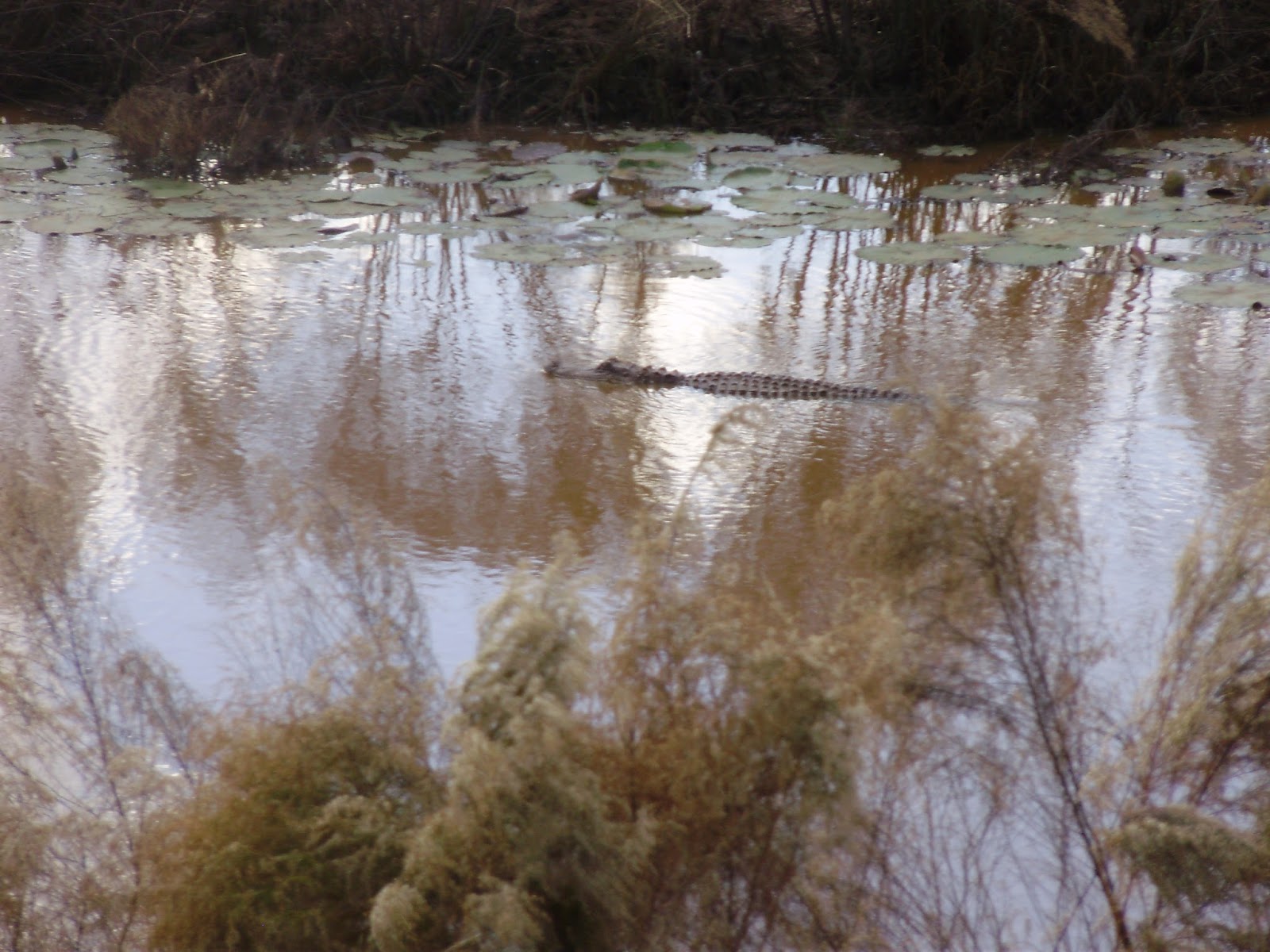
waterway, no less—I naturally kept my camera around my neck and my
eyes peeled for those characteristic horny ridges protruding just
above the surface. (Look in center of photo, behind the reeds.)
By the way, did I tell you about our
Thanksgiving plans? We docked the boat in Bluffton on the May River.
We briefly considered the down-home country fare of the local diner,
which promised lots of thick, creamy, fatty, meaty gravy...
...but stuck to the plan to attend
Pope's annual family reunion. The feast began with Bluffton oysters—a
tradition in the Lowcountry—served outside on a lovely warm day,
under massive trees that predate the Civil War.
Then we progressed into a buffet with
the usual turkey and trimmings, served up by a few dozen of Pope's
cousins, uncles, great-nieces, and the like. But I'm getting ahead of my story. It's the locale, not the food or the family, that got my heart
racing and put my photographer's instincts on guard.
We dined on the grounds of a former
rice plantation, owned by a not-too-distant ancestor. Much of the
real estate, including the rice paddies formerly tended by 386 slaves (up
until the Civil War) now makes up the Savannah National Wildlife
Refuge. The former rice ponds are surrounded by a system of dikes.
The family heirs live and raise cattle on an in-holding, a
large estate at the end of a long dirt road, right smack-dab in the
middle of the wildlife refuge.
Which makes for an interesting commute,
because the former rice paddies are full of wild alligators. (Anyone up for walking to work today?)
Oh, there are birds and snakes, too, of
course, but aren't those big horny beasts with their exceptionally
long jaws infinitely more interesting?
Not one to willingly let such a
fortuitous opportunity pass, I decided to forgo the usual
after-dinner nap in favor of a brisk turn along the road in search of
wild alligators in the canals and ponds of the former plantation. I was not disappointed.
Besides the
five I saw swimming—or, more accurately, lurking—in the water, a
large adult specimen appeared on a bank practically under my feet,
just outside the entrance to the plantation. (Look at lower left of photos--the big gray horny blob with tail just touching the grass.) He seemed innocent
enough--lazily sunning himself, probably--but, for the sake of prudence, I
kept my distance.
Not the usual holiday fare, and certainly not something we considered when making our plans.
Alligator for Thanksgiving, anyone?
Subscribe to:
Posts (Atom)